Jay Dixit
Award-winning writer and editor, writing professor, and OpenAI's first Head of Community for Writers. 15 years translating scientific and technical information into clear, vivid, engaging prose for lay audiences at Psychology Today, The New York Times, Harvard Business Review, The Washington Post, Rolling Stone, and Wired. At OpenAI, I authored flagship AI education resources and developed “Socratic AI,” a framework adopted by educators at Harvard, Wharton, Babson, Columbia, and CSU Fresno.
15 years of helping experts tell their stories in their own voice.
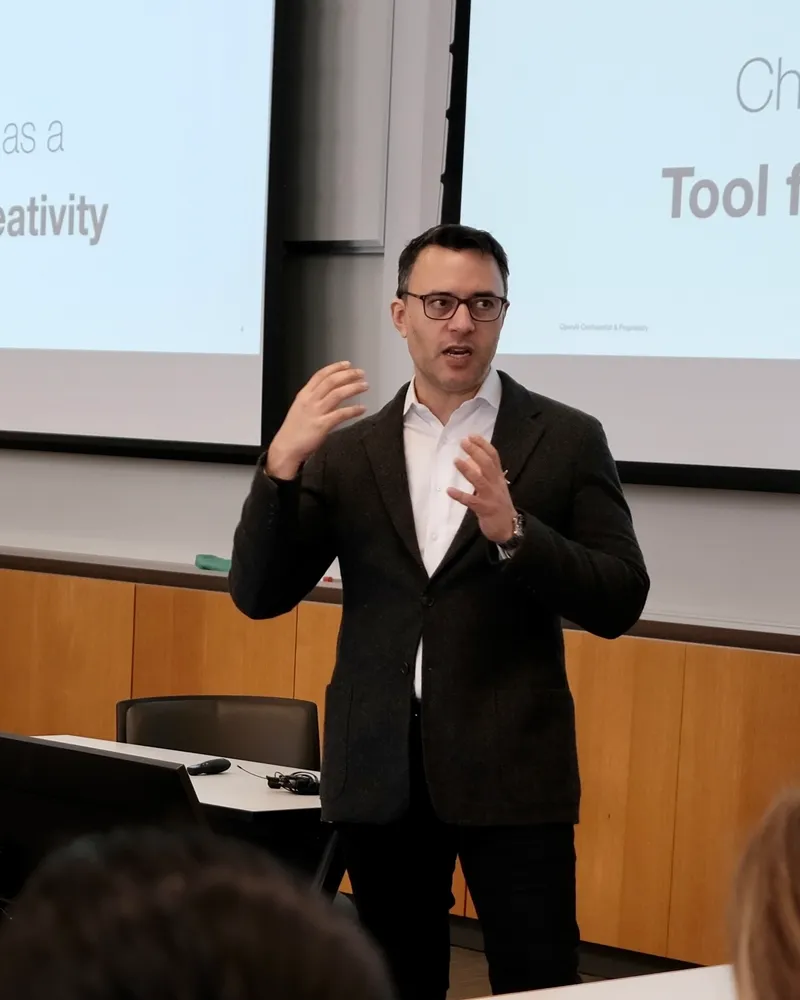
Hint: Don’t ask AI to be creative — ask it to help you be creative.
Experience
Socratic AI
- Founder: Guide knowledge workers, companies, and students away from using AI to generate content and toward using AI as a thinking partner — one that helps them aim higher, think more rigorously, and surface their own best ideas.
- Recent keynotes and talks include SXSW EDU, Yale U.S.-China Forum, and PopTech.
OpenAI
First Head of Community for Writers: Led OpenAI's strategy to engage the writing community, guiding writers and educators away from using AI to generate content and toward using AI as a thinking partner.
AI Education
- Guided writers, professors, and students on how to use ChatGPT thoughtfully and ethically — as a tool to surface our best ideas, clarify our thinking, and amplify human creativity.
- Created a framework I call “Socratic AI” — using AI not to generate prose, but as a Socratic thinking partner: to surface one's own best ideas, express them with greater clarity and precision, and improve the work through iterative feedback.
Traditional approach: “Suggest a nuanced thesis statement I can use for my essay.”
Socratic AI: “Ask me tough questions to help me clarify my thesis.” ✅
Impact: My method has been adopted by educators at Harvard, Wharton, Babson, Columbia, Simon Fraser University, and across the California State University system as part of a 460,000-student rollout.
Thought Leadership and Storytelling
- Authored OpenAI's flagship AI education resources, including a guide for writers and a student writing guide, widely praised internally and externally as some of the company's strongest public-facing writing.
- Wrote guides on how to leverage ChatGPT for brainstorming, wordfinding, research, and image gen.
- Wrote messaging about AI and writing that was presented by Sam in interviews, shared widely in viral social posts, and covered in major press outlets.
Speaking & Scalable Training
- Designed scalable training to help faculty and students use AI to strengthen critical thinking and writing skills, not outsource the thinking process.
- Trained faculty "hubs" — writing professors and thought leaders with large audiences — on the principles and techniques of effective prompting.
Institutional Partnerships & Public Engagement
- Delivered AI literacy curricula to over 1,000 faculty and students, giving talks at Harvard, Wharton, Columbia, Cal State, Babson, Carleton, and the Poynter Institute, helping shape AI practices in academic and creative settings.
- Represented OpenAI at writing conferences, film festivals, industry events, and university campuses.
- Organized and hosted OpenAI creative community events in New York City, at the Toronto International Film Festival, and at AWP (the Association for Writers and Writing Programs).
Community Building & Research Collaboration
- Built and led a high-trust cohort of writers, journalists, and educators who became champions of thoughtful, ethical AI use, including community showcases featuring Steven Pinker, Ken Liu, Dan Shipper, Farhad Manjoo, and Alexandra Samuel.
- Worked directly with research teams to understand technical capabilities and translate them into practical guidance for writers, bridging the gap between AI capabilities and creative applications.
- Led early access cohorts of professional writers to alpha-test Canvas, Search, Operator, Deep Research, Image Gen, and Advanced Voice Mode before launch, surfacing use cases and providing feedback to research and product teams.
- Maintained strategic feedback loops between the writing community and research and product teams, shaping the development of new models and helping align development with the needs and values of the creative community.
Impact
- Transformed OpenAI's positioning from ‘ChatGPT as prose generator’ to ‘ChatGPT as creative tool,’ helping shift public sentiment from fear to curiosity and establishing lasting goodwill among writers, educators, and creatives.
- My Socratic approach helped inform ChatGPT Study Mode, bringing questioning-based pedagogy into a product used by tens of millions of students.
Yale University
- Lecturer: Taught “The Art of Storytelling,” an undergraduate writing seminar. Coached students through the writing and revision process, drawing out their ideas, helping them structure their material, and editing their work draft by draft while preserving each student's voice.
- 150 students applied for 12 spots — 10% of Yale's senior class.
- Developed a practice-driven curriculum grounded in the psychology of attention, emotion, and memory, covering suspense, stakes, character, scene-building, and humor across fiction, nonfiction, screenwriting, playwriting, and spoken-word storytelling.
The NeuroLeadership Institute
- Senior Science Writer: Ghostwrote articles for CEO David Rock, publishing in Harvard Business Review, Strategy + Business, Quartz, and Fast Company on the psychology and neuroscience of creativity, performance, and unconscious bias.
- Wrote video scripts for corporate training videos distributed to over 300,000 employees at clients including Boeing, Merck, Kaiser Permanente, and Panasonic.
Storytelling.NYC
- Founder, Storytelling Trainer: I lead storytelling classes, writing workshops, and corporate training for companies across the country.
- Created The GHOST Method, a practical storytelling framework that emphasizes the primacy of character, emotion, and suspense, and meaning over the delivery of information or the composition of pretty sentences.
Downtown Project
- Community Director: Designed curriculum and business strategy for a creative writing school funded by Tony Hsieh's $350M Downtown Project initiative.
William Morris Endeavor
- Editor-In-Chief: Created, wrote, and edited Flashbulb: Dispatches from the Frontlines of Science, a daily publication covering breakthroughs in neuroscience, behavioral science, robotics, biology and biotech, artificial intelligence, and emerging technologies. Set editorial strategy, identified stories across a portfolio of technical fields, and sustained a daily publishing cadence.
Psychology Today Magazine
- Senior Editor: Edited feature articles end-to-end, from substantive editing on story, science, and craft through to rewrite and line editing, guiding writers from first draft to final publication while preserving each writer's distinctive voice.
- Wrote 15+ cover stories translating psychology and neuroscience research for lay audiences, covering topics including happiness, personality, love, dating, procrastination, and decision-making.
- Interviewed psychologists, behavioral economists, and neuroscientists to draw out their research insights and turn them into accessible feature articles.
- Generated ideas, recruited writers, and assigned stories.
- Interviewed celebrities such as Tim Roth, Willem Dafoe, and Will Shortz.
- Conducted George Carlin's last interview, which Carlin called the “most complete” interview he'd ever done.
Philadelphia Magazine
- Research Editor: Led the seven-person, magazine-wide research department. Verified all factual information across the publication.
- Generated story leads, conducted research, interviewed sources, and wrote articles.
Additional Publications
- The New York Times
- The Washington Post
- Harvard Business Review
- Rolling Stone
- Wired
- Slate
- Psychology Today
- Freelance Writer: Beyond staff roles, wrote feature articles for The New York Times, The Washington Post, Rolling Stone, Wired, Slate, and Psychology Today.
- Wrote front-page stories for The New York Times City Section, including "Take My Life, Please" and "Saving a Comedy Club."
- My article about pen cloning, "Cats with Ten Lives," appears in the anthology Best of Technology Writing.
Keynotes and Talks
- In addition to teaching at Yale, I've spoken at Harvard, Columbia, Wharton, Babson, California State University at Fresno, The Poynter Institute, and the Brown Institute for Media Innovation, as well as SXSW EDU and PopTech.
- Harvard CS50: Guest lecture on AI and writing for Harvard's legendary introductory computer science course.
- I've delivered keynote talks and workshops to audiences of up to 2,000 at Amazon, Bank of America, The NeuroLeadership Institute, and OpenAI.
Education
University of King's College, Dalhousie University
- MFA in Creative Nonfiction Writing, 2024. Thesis: a book-length exploration of the psychology of romantic relationships, drawing on research in evolutionary psychology, behavioral economics, and neuroscience.
Yale University
- B.A. cum laude in psychology with distinction in the major, 1998.
- Studied nonfiction writing under Fred Strebeigh and Robert Stone.
- My senior thesis in psychology was published in The Journal of Social Issues and has been cited 425 times.
- Two of my articles, "www.nazi.com" and "Gangbuster," were required reading for many years in Yale nonfiction writing classes.
Skills and Hobbies
- Vibecoding using Claude and Claude Code: I've used Claude and Claude Code to build tools and systems, including an Astro site for Socratic AI, a photography portfolio for my red carpet work for Wikipedia, a continuous scrolling calendar app, transitpaths, transcription tools, writing streak visualizers, and a tool to categorize and pull articles about AI from my Readwise library.
- For more than ten years, I've done 100% of my writing in Emacs.
- Photography: Red carpet photographer for Wikipedia, and have covered Sundance, SXSW, the Toronto International Film Festival, and The Nobel Prizes.
- Languages: Fluent French, pretty good Spanish
- Storytelling: Winner of The Moth StorySLAM. My story “My Father's Love” was featured on The Moth Radio Hour on NPR and produced as the short film In Transit. Appeared on CBC Radio discussing AI and writing.